
Interview for De Limburger
Tango as a Bridge Between People, Cultures, and Communities
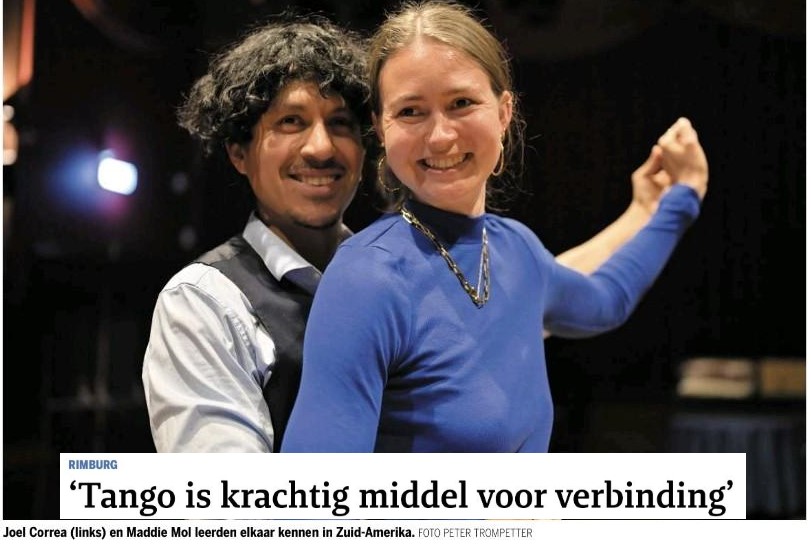
A recent feature in a Dutch newspaper highlighted the story behind TangoMJ and the vision that Joel Correa and Maddie Mol are bringing to the Parkstad region: using Argentine tango not only as a dance, but as a powerful way to create human connection.
Every Friday evening, the community center in Brandpoort transforms into a small piece of Argentina. The sound of tango music fills the room while people of different ages and backgrounds come together to dance, talk, laugh, and share experiences. According to Joel and Maddie, this atmosphere of connection is exactly what tango is about. More than choreography or performance, tango creates encounters between people and helps overcome cultural and social barriers.
Joel Correa grew up in Buenos Aires, surrounded by the rich traditions of Argentine tango. He trained and performed in prestigious tango environments and was part of the internationally known Homero Manzi Café Show. Through his experience, he discovered that many people outside Argentina have misconceptions about tango. Some imagine it as an old-fashioned dance only for older generations, while others see it as something overly serious or inaccessible. However, Joel explains that tango is constantly evolving and has always been deeply connected to communication, emotion, improvisation, and human interaction.
For Maddie Mol, tango began as a personal discovery during her student years in Wageningen. What started as curiosity quickly turned into a passion. In 2016, she traveled to South America for several months to dive deeper into the dance and its culture. During that journey, she met Joel. Their shared love for tango eventually became both a relationship and a professional partnership.
Their story reflects one of the central ideas of tango itself: connection. Even though they grew up in completely different cultures — Maddie in the Netherlands and Joel in Argentina — tango became a common language between them. As they explain in the article, dancing together teaches people to listen, adapt, and communicate in ways that go far beyond words.
Joel describes tango as a kind of “language of dance.” Especially in modern society, where people often become disconnected from their bodies and from direct human interaction, tango offers something unique. It encourages people to slow down, become aware of music and movement, and develop trust and sensitivity with another person. According to Maddie, dancing helped her become more open and expressive, while Joel believes tango helps people rediscover an important human need for closeness and real connection.
Another important aspect of their work is community building. Through TangoMJ, they aim to create an inclusive and welcoming environment where beginners feel comfortable and experienced dancers continue to grow. Their classes focus not only on technique and figures, but also on musicality, communication, posture, creativity, and emotional presence. Students are encouraged to develop their own style while learning to dance with respect and awareness of their partner.
The newspaper article also highlights how tango naturally brings together people from different generations and cultural backgrounds. In a world where many activities are increasingly individual and digital, tango creates real social interaction. People meet face to face, embrace, move together, and share moments that feel authentic and personal. This is one of the reasons why Joel and Maddie believe tango has such a positive impact on people’s lives.
The article also mentions the inspiration behind one of their special events: Las Tres Esquinas. The name refers to one of the historic tango cafés in Buenos Aires, a place deeply connected to traditional Argentine tango culture. By choosing this name, Joel and Maddie wanted to create a symbolic bridge between Argentina and Limburg — bringing the atmosphere, music, and social spirit of Buenos Aires into their local community. Their goal is not simply to teach dance steps, but to share the cultural essence of tango: connection, music, embrace, and shared experience.
Beyond weekly classes, TangoMJ also organizes dance evenings, workshops, and cultural activities that bring a taste of Argentine tango culture to Limburg. Their events are designed not only for dancers, but for anyone interested in music, culture, and meaningful social experiences.
For Joel and Maddie, tango is much more than entertainment or a hobby. It is a living cultural tradition that combines music, movement, emotion, and community. Through TangoMJ, they hope to continue creating spaces where people can meet, grow, and connect — one dance at a time.